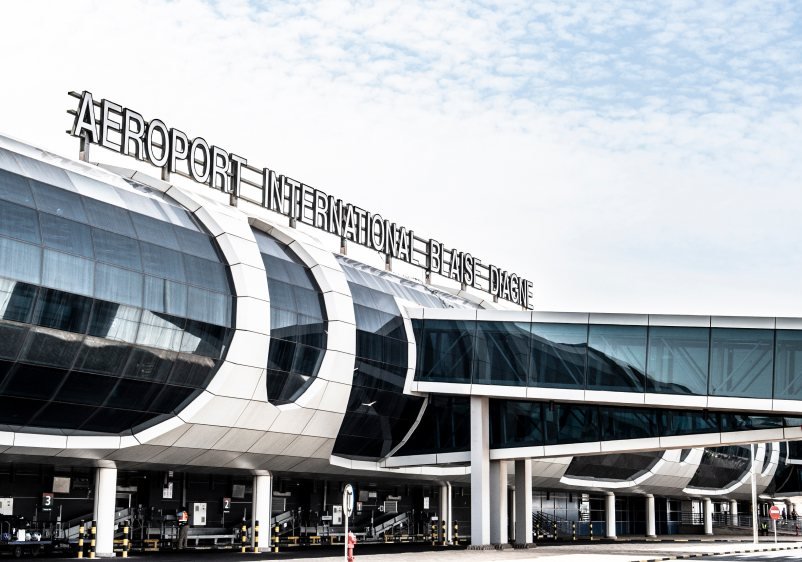
For an athlete, a coach, a journalist or a visitor, Senegal will not begin at the stadium or the hotel. It will begin at the jet bridge, in the terminal, on the road into town. That is where the first impression forms, and it is the one visitors will take home.
The country's antechamber
The course was set in January in Diass, when the Games organising committee signed agreements with the airport community: AIBD SA, the operator LAS and 2AS, the main ground handler, with ANACIM for civil aviation and weather, and Senegal's High Authority of Airports for security.
“The airport is our country's antechamber. We must be beyond reproach, from our guests' landing to their take-off.”
Cheikh Bamba Dièye, Director General of AIBD SA, January 2026 (our translation)
The stakes can be measured: nearly 15,000 people expected over a very short period, athletes, officials, delegations and media, and a target of twenty minutes on average from leaving the aircraft to leaving the terminal.
The shortest way into West Africa
The showcase lasts a fortnight; the position stays. From Lisbon, Dakar is 2,790 km away, while Abidjan, Accra, Lomé and Lagos are more than 3,750 km. From Paris, 4,220 km against at least 4,720. From New York, 6,160 km, while Abidjan is 7,930 and Lagos 8,440. For anyone leaving Europe, North Africa or North America, no major gateway in the region is closer.
Dakar against the nearest other major gateway
Dakar, then the nearest of Abidjan, Accra, Lomé and Lagos. Great-circle distances calculated by Teral Travel.
A gateway before a hub
The 2025 traffic says the same. Of 2.94 million passengers, 97.7% were international. Transit fell by 15.9%, but direct traffic grew by 1.43%, driven by Europe (+5.46%) and North America (+5.55%). Those who land in Diass are coming to Senegal: that is the strength of a gateway.
The three Games cities within reach of the runway
The old Yoff airport sat at the tip of the peninsula: ten kilometres from the Plateau, but sixty from Thiès and Saly. Diass stands where the motorway to Dakar, the motorway to Mbour and the branch to Thiès meet. The three Games cities are less than forty kilometres from the runway as the crow flies: Diamniadio 14, Saly 25, Dakar's Plateau 39.
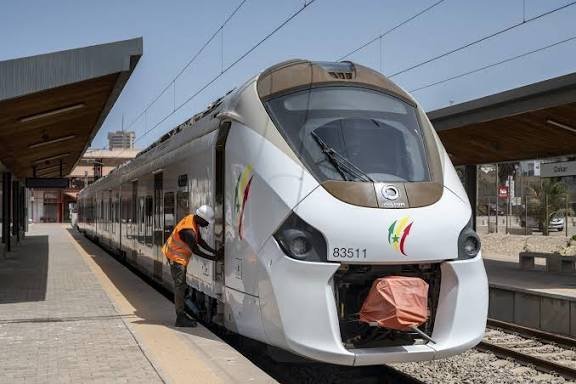
Since 28 September 2026, the TER train also serves the airport: a train every 24 minutes to Diamniadio, central Dakar in about 55 minutes, for 4,000 CFA francs in second class.
After the Games, the door stays open
From 1 to 3 December, MSGBC Oil, Gas & Power delegates will head to the CICAD, 14 km from the runway, without crossing the capital. An executive running a seminar in Saly takes the Mbour motorway straight from the terminal. Someone with a meeting at a ministry on the Plateau takes the train and is back the same evening. Three trips, one door: this position is what sells, to congress organisers and airlines alike.
The missing piece
Each player publishes its own part: the airport, its list of airlines and its taxi fares; the TER, its timetable; the airlines, their flights. No single page yet brings together the plane, the train and the road, destination by destination. That is the job of Show Me Teranga, the Teral Travel guide launched this Monday: it saves to the phone before boarding and can be read in flight, offline.
Key point
For a fortnight, Diass will be Senegal's first impression for the world of sport. All year round, it is the major West African gateway closest to Europe and the Americas, at the centre of the places where the country hosts: Dakar, Diamniadio, Thiès and the Petite Côte.
Airlines, airport, ground handling
Show Me Teranga can accompany your passengers from the moment their booking is confirmed, then on board, offline. Let's talk.
Write to us →